processing technology that they say will bring 50% power reduction at constant performance (that means better battery life) and 37% performance increase at low voltage – a better job for less!
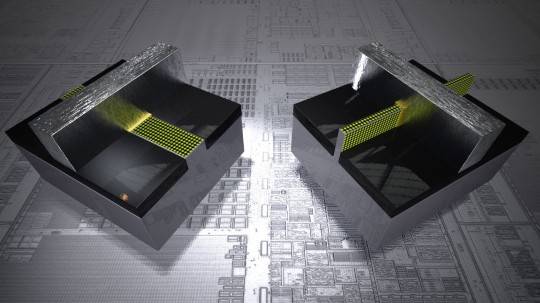
So what is 22nm – what’s that mean? “nm” stands for nanometer, one nanometer is equal to one billionth of a meter. In the semiconductor industry, this unit is used to describe the wavelength of light. All you and I really need to know is that this is the newest, the best, where back in 1989 we were at 800nm, 2002 we were at 90nm, and now we’re all the way down to 22nm. Again, this follows the plan – Intel had their OG Gordon Moore send out a quote on the matter.
“For years we have seen limits to how small transistors can get. This change in the basic structure is a truly revolutionary approach, and one that should allow Moore’s Law, and the historic pace of innovation, to continue”
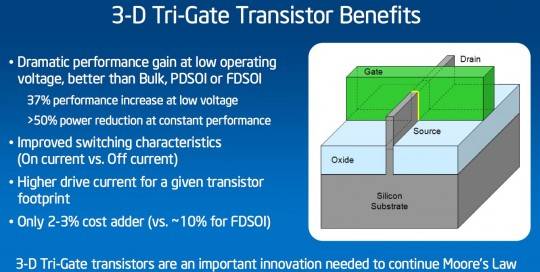
Next, what does “3D” stand for here? Hint – there’s no double camera tricky business going on here. It’s got to do with the structure of the transistor. The 3D Tri-Gate transistors form conducting channels on three sides of a vertical fin structure. This build results in less heat transmission, longer battery life in mobile devices, and because of a combo of the high-k gate insulators and strained silicon, improved performance.



So what is 22nm – what’s that mean? “nm” stands for nanometer, one nanometer is equal to one billionth of a meter. In the semiconductor industry, this unit is used to describe the wavelength of light. All you and I really need to know is that this is the newest, the best, where back in 1989 we were at 800nm, 2002 we were at 90nm, and now we’re all the way down to 22nm. Again, this follows the plan – Intel had their OG Gordon Moore send out a quote on the matter.
“For years we have seen limits to how small transistors can get. This change in the basic structure is a truly revolutionary approach, and one that should allow Moore’s Law, and the historic pace of innovation, to continue”
Next, what does “3D” stand for here? Hint – there’s no double camera tricky business going on here. It’s got to do with the structure of the transistor. The 3D Tri-Gate transistors form conducting channels on three sides of a vertical fin structure. This build results in less heat transmission, longer battery life in mobile devices, and because of a combo of the high-k gate insulators and strained silicon, improved performance.
Intel notes the following to confuse and excite you:
Tri-gate fully-depleted substrate transistors have a raised plateau-like gate structure with two vertical walls and a horizontal wall of gate electrode. This three-dimensional structure improves the drive current while the depleted substrate reduces the leakage current when the transistor is in the “off” state. Reducing leakage current not only helps control heat at the circuit level but also translates to increased battery life in mobile devices.
You can expect some other bits that you may or may not be super excited about from an Android standpoint: native PCIe 3.0 and USB 3.0 controllers at the processor level as well as an integrated DirectX graphics core with support for the second-generation of QuickSync. QuickSync is Intel’s media encoding/decoding acceleration technology, in case you do not know.
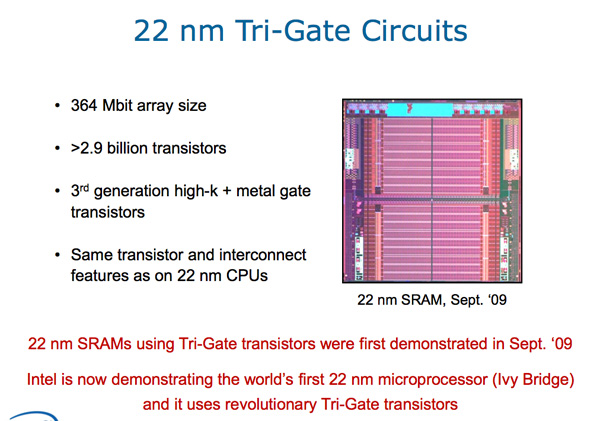
The first application of this technology will be in Intel’s Ivy Bridge processors, demonstrated today on some high-volume CPU’s, as noted by our sister site SlashGear. Have a peek at some videos while we’re at it and see where Intel is at with the project at the moment

